
What nobody talks about in the AI sales pitch
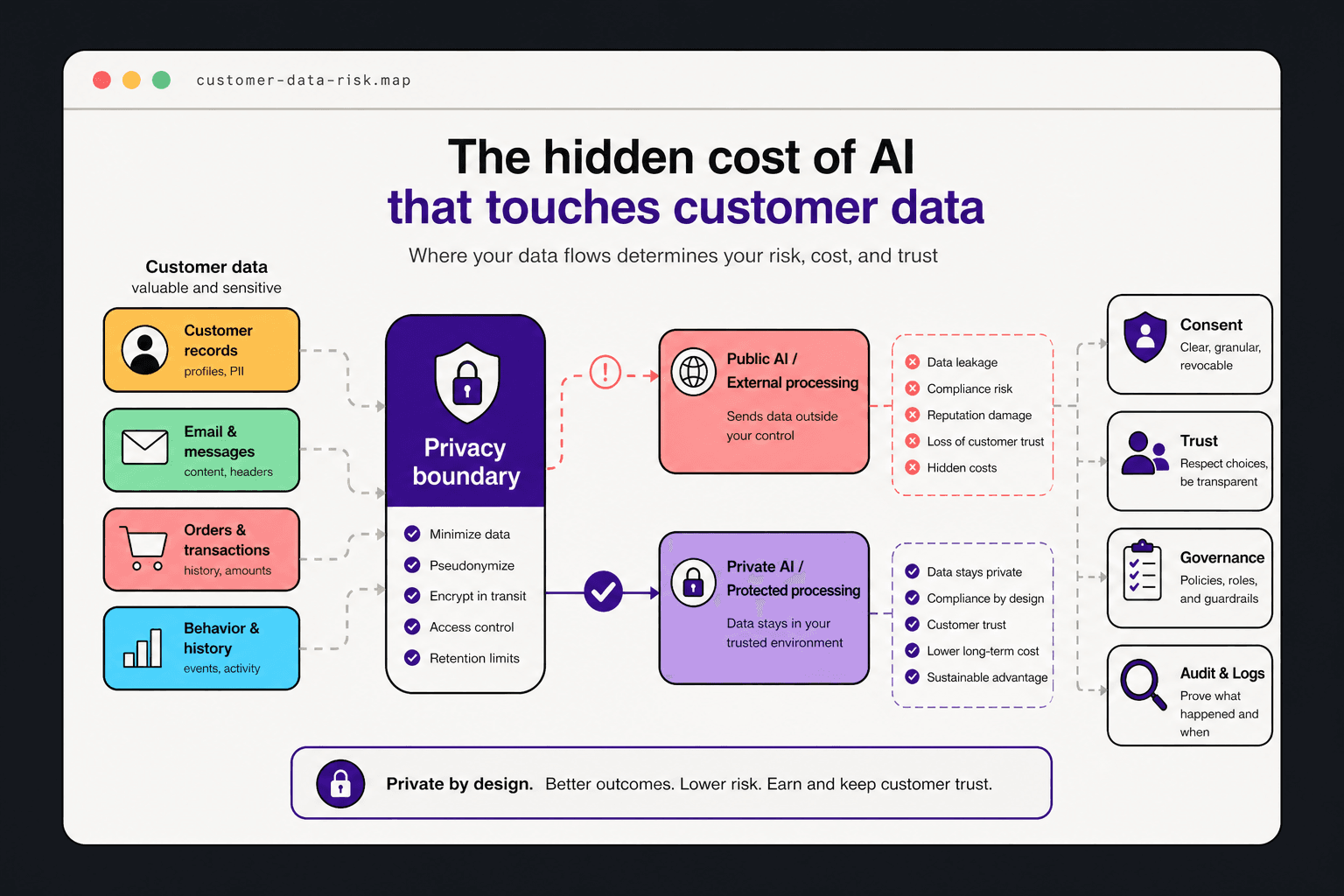
When a vendor demonstrates an AI workflow that automatically reads your emails, summarizes support tickets, or drafts responses to customers — ask one question: where does the data go?
Most cloud AI services send your data to a provider's model inference infrastructure. In many cases, that data is used to improve the model unless you opt out, and opting out requires enterprise contracts that most small businesses never negotiate.
The three categories of customer data risk
Identifiable personal information — names, emails, addresses, purchase history — creates the clearest risk. Most jurisdictions have rules about where this data can travel and who can process it.
Sensitive business context — pricing strategy, supplier relationships, customer contract terms — may not trigger privacy law but exposes competitive information to a vendor's model ecosystem.
Behavioral patterns — how your customers interact, what they buy, when they contact you — are often the most valuable data you have. They are also the most attractive to AI providers building training datasets.
Why 'we read the terms of service' is not enough
Enterprise AI terms change. A model provider can update their data retention policy in a quarterly update that gets buried in an email most operators never read.
A business that built workflows on a platform's current terms has no automated way to detect when those terms change. Privacy governance needs to be structural, not manual.
What private deployment actually changes
When a model runs on infrastructure you control — whether on-premises, in a private cloud, or through a client-owned provider account — your customer data never leaves your environment.
This is not an abstract IT preference. It is a concrete answer to the question every customer will eventually ask: 'Is my data being used to train AI systems I did not agree to?'
The compounding cost of waiting
A privacy incident with customer data costs more than the audit that would have prevented it. Legal response, customer notification, regulatory review, and reputational repair routinely run into six figures for businesses that could have deployed privately from day one.
The decision to build properly is always cheaper before the incident than after it. The question is whether the organization treats data governance as a line item or as a foundation.
Ready to act?