
Why the model is almost never the problem
When AI automation projects stall or underperform, the root cause is rarely the language model. The model can reason, summarize, classify, and draft. What it cannot do is reach into a system it has no connection to.
The most common silent failure in AI automation is an assumption: that the data needed for a workflow will be available when the automation runs. It usually is not — at least not in the form or location the design assumed.
The four connector types you need to map
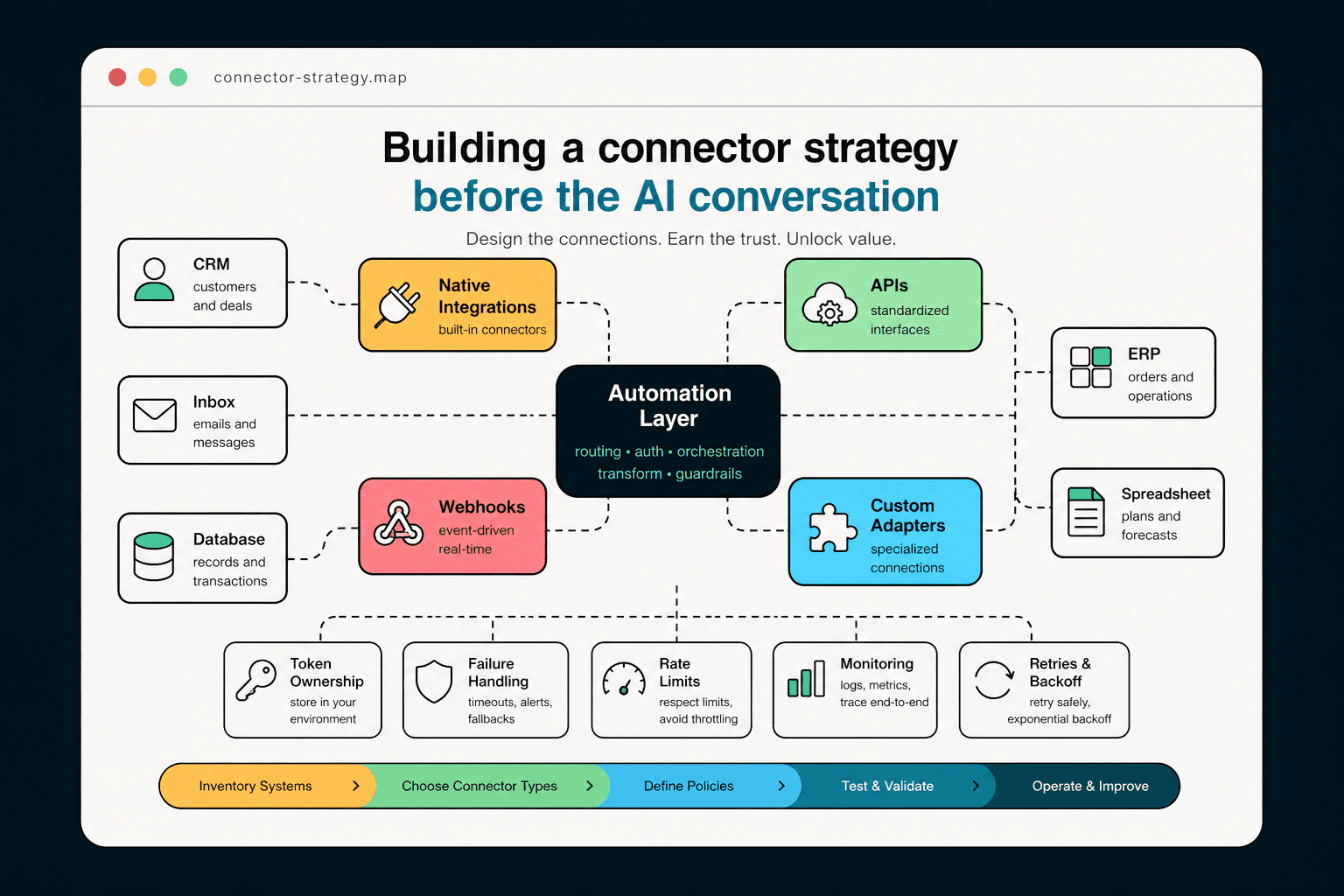
Native integrations are pre-built connections between platforms — the fastest to activate, the most limited in scope. API integrations require authentication and endpoint knowledge but cover most modern SaaS tools. Webhook connectors handle event-driven data streams. Custom adapters bridge legacy systems, databases, and proprietary formats that nothing else can reach.
Every automation workflow touches at least two of these types. Most touch all four at some point in their lifecycle.
The mapping exercise that most teams skip
Before designing any automation, list every system the workflow needs to read from or write to. For each system, document: Is there a public API? Is it authenticated? Who owns the credentials? Are there rate limits? What happens when the connection fails?
This exercise consistently surfaces two or three dependencies that nobody had thought about — a legacy CRM with no API, an accounting system that requires manual export, a supplier portal that only supports email.
Designing for connection failure
Production automation workflows fail in predictable ways: authentication tokens expire, APIs return unexpected status codes, rate limits kick in at peak volume, and third-party services go down.
Connector strategy includes failure design: retry logic, fallback queues, human escalation paths, and monitoring that alerts the right person when a connection breaks. Automation without this is fragile by construction.
Making connector health an operational metric
After deployment, connector health needs to be monitored like uptime. A broken integration does not always surface as an obvious error — it often silently produces incomplete outputs or drops records without notification.
The businesses that get maximum value from AI automation are the ones that treat their integration layer as operational infrastructure, not a one-time configuration project.
Ready to act?