
The best first workflow is usually boring
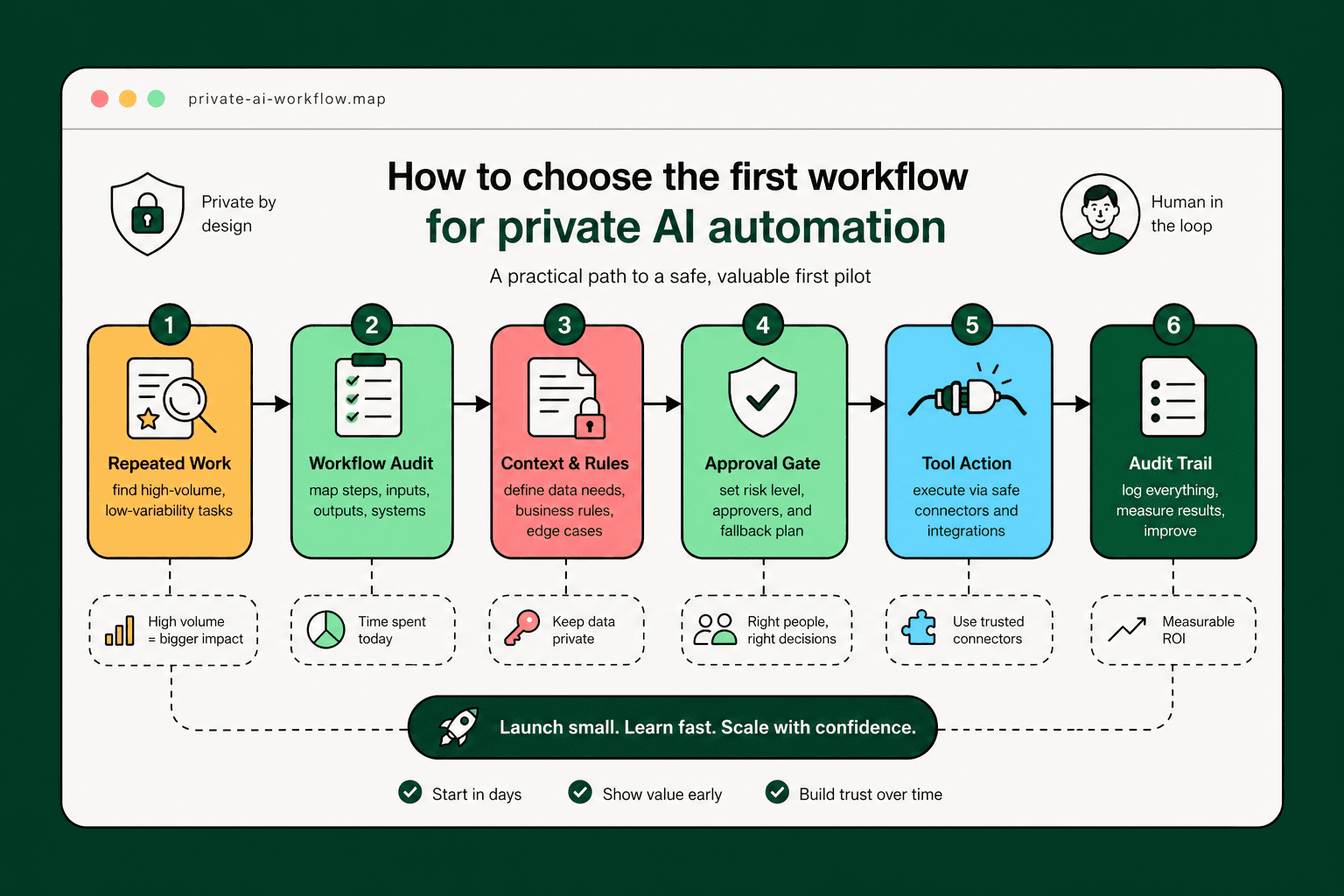
The first private AI automation should not be the riskiest process in the company. It should be a repeated workflow that eats time every week and already has a clear owner.
Lead routing, support triage, invoice checks, weekly reporting, order exception handling, and internal admin are strong candidates because the work is visible, measurable, and usually rule-driven.
Score the workflow before building
A workflow earns a pilot when it has enough volume, predictable inputs, available connector paths, and a clear definition of what should require human approval.
If the workflow needs five undocumented decisions, missing access, and sensitive customer context with no approval policy, it belongs in discovery before it belongs in production.
Separate reasoning from action
The agent can interpret the request, summarize context, and recommend the next step. The automation layer should execute the tool action through approved connectors, APIs, webhooks, or custom adapters.
That separation makes the system easier to inspect. It also gives the business a practical place to add approvals, rollback rules, and logs.
Design privacy posture per workflow
Some work should run through a private or local model. Some work can use client-owned provider keys. Some workflows need hybrid routing where sensitive context stays private and lower-risk tasks use approved external services.
The important part is deciding the boundary before the pilot ships, not after the first uncomfortable data question appears.
What the audit should produce
A useful audit should produce a workflow map, automation opportunity score, privacy architecture recommendation, connector plan, approval rules, and a pilot roadmap with effort, risk, and expected time saved.
That becomes the bridge between AI interest and a real operating system: one workflow shipped cleanly, then a backlog that can expand without losing control.
Ready to act?